

Handling the media onslaught on housing and migration — June 2026
After weeks of anti-migrant rhetoric and racist attacks in Belfast and elsewhere, here is a summary of news and hostile commentary on housing and migration, and responses to them.
Housing and community agencies respond to the Belfast attacks
Hundreds of people were made homeless by the fires and riots in Belfast, with 29 households assisted by the Northern Ireland Housing Executive.
Imix news service provided regular updates with links to corporate media and local news sources, especially in their issue of 9-10 June. In openDemocracy, Nicola Browne described solidarity among ordinary Belfast residents to help those affected. A local group, the Anaka Collective, described how it is supporting people affected by the attacks.
CIH Northern Ireland put out a statement on the violence, as did JCWI. PAIH (Positive Action in Housing) made a statement about violence in Glasgow.
Belfast riots fuelled by publicly available lists of multi-occupied homes
The Guardian reported that Belfast rioters were targeting houses in multiple-occupation (HMOs) as likely places where migrants were living, using the public HMO register.
HOPE not Hate has put out the following call to local authorities in the rest of the UK, asking them to create identity checks before people can access their HMO registers:
The following is some information about public HMO registers, in the light of recent riots and disturbances. Please pass this along to housing officers and information governance officers as appropriate.
As you will be aware, local authorities have a duty under the Housing Act 2004, Section 232 to maintain an up-to-date register of properties within its jurisdiction that have been granted House in Multiple Occupation (HMO) licences, and ensure that that list is accessible to the public.
We have evidence to suggest that, during recent unrest, there have been incidences of individuals sharing details of properties taken from HMO registers. This has then been used to build lists of places to target as suspected accommodation for people seeking asylum. This follows a pattern we have seen within the organised far right, namely a move from focusing on asylum hotels to targeting HMOs, on the (mis)understanding that ‘HMO’ is synonymous with dispersal asylum accommodation. As such, we believe that any property that has an HMO licence, or indeed that appears visually similar to HMO-licenced properties, may be at greater risk.
We wanted to make local authorities aware of this trend and encourage those who maintain their public register in an online format to consider moving to a different format. This could mean, for example, implementing a procedure whereby those wanting to access the register must apply by sharing their full identifying details. Applicants would then be able to access the list at an in-person meeting. Section 232 of the Housing Act 2004 simply states that “the register must be available for public inspection and persons may take copies thereof (on payment of a fee).” We believe that this duty would be satisfied by a system that allows individuals to view the register in person, having made a note of their details.
Please be aware that, where the details included in the public register were previously available in an online format but have since been taken down, they may still be accessible using tools like the Wayback Machine, which enables users to view previous versions of webpages. If your authority deems this an ongoing risk, you may wish to consult with people with relevant IT knowledge and contact providers, including the Wayback Machine, with a takedown request.
If you would like further information about this, please contact HOPE not hate’s Community Tensions Researcher Mary Atkinson on mary.a@hopenothate.org.uk.
Farage promises to “evict foreign nationals from council housing”
A Daily Telegraph headline heralded an attack on all non-UK nationals living in social housing. A Reform government would give such households three months’ notice to find alternative accommodation, with those failing to do so being deported.
There was no acknowledgement of the enormous obstacles to carrying it out. Housing associations and many local authorities could refuse to implement it. The costs of evictions and tenancy turnover – especially in London where huge numbers could be affected – would be prohibitive. The end result might well be a larger housing benefit bill if households were forced to move into private lettings, even if the private sector could meet the additional demand.
CIH made an immediate response, criticising the proposal.
Adding to the attacks, the Daily Express had a related story that Reform would remove welfare rights from all foreign nationals at three months’ notice. This would eventually extend to those holding EU settled status, with the party estimating savings of “up to £10 billion a year on universal credit alone.” The move would conflict with the legally binding Brexit agreement.
On Monday 25 May, the Express claimed that “almost half of new homes go to migrants.” This was based on an assessment of recent new housebuilding numbers compared with arrivals of new migrants. On the BBC, the programme More or Less debunked the claim. The numbers had been crunched by the Conservative Party, who failed to point out that, by the same logic, the numbers were far worse under the previous government.
Migration is falling – is that good news?
Yorkshire Bylines asked a question that gets to the heart of the current political moment: why, given that net migration has fallen to its lowest level in over a decade, has the fury only intensified? The piece draws a clear line from Brexit’s normalisation of dehumanising language to the current climate, and notes that some of the most hostile responses to the government’s statistics were directed at Diane Abbott and David Lammy specifically, using openly racist language. The far-right cannot be appeased by numbers, the piece argues, because the numbers were never really the point.
The Bureau of Investigative Journalism asked, “UK net migration is at its lowest in ten years – so why is the country fixated on it?” In part it’s because most voters don’t believe the statistics. A study published by the thinktank British Future found most voters believe net migration is still rising. Also, if high immigration is no longer an issue, attention may turn to migrants’ effects on the housing market and related questions.
James Bowes, who forecasts that UK net migration will fall to zero, repeated his arguments in UnHerd. As a result of falling numbers, Labour MPs will “urge ministers to scrap migration reforms”, said The Independent. MPs argue that, since net migration is set to drop to its lowest level since Covid, Shabana Mahmood’s pending changes – for example on “earned settlement” – should be abandoned.
Immigration to the UK: Escaping the doom loop
In a new report, Lauren Gilbert and Jonathan Portes argue that “whoever is in charge, Labour needs a new immigration strategy.” Evidence that net migration has almost halved won’t help the government regain trust, they say.
“This is the migration doom loop,” says the report. The government responds to political pressure by promising to reduce numbers. The easiest reductions come from routes that are economically useful and administratively controllable: students, skilled workers, dependants, care workers. The fiscal and labour market costs then show up elsewhere, in weaker public services, lower tax revenues and more pressure on universities and care. Meanwhile, the political focus on immigration policy simply raises its salience. And in the UK’s current media climate, few believe that government policies achieve anything. Dissatisfaction rises, and the right says the problem is still immigration.
The report argues for dropping the “earned settlement” proposals because of the vast uncertainty they will create, having a proper strategy for having sufficient social care workers, having a strategy for students, speeding up asylum decisions and other administrative measures.
On housing, the report says:
“Restricting migration does not materially increase housing supply, resolve funding constraints in social care, or raise capital investment. Instead, it reduces labour supply and fiscal capacity, making these problems harder to address.”
Lauren Gilbert also took a dive into the evidence on whether migration drives up house prices. She concludes that they do (at least in the US), but that the issue is complicated because migrants are also needed to build new homes (a quarter of US construction workers are migrants). In any case, price rises due to other factors are far more significant than the small impact of extra migration.
Britain has crushed immigration, and harmed itself – “Nobody seems to have noticed”
Perhaps surprisingly, The Economist joined the calls for more enlightened immigration policies. “In a few years Britain has gone from a remarkably open country to a remarkably closed one,” it argues. “A considerable achievement, though not a commendable one. Under public pressure, successive governments have slashed every kind of immigration that they can.”
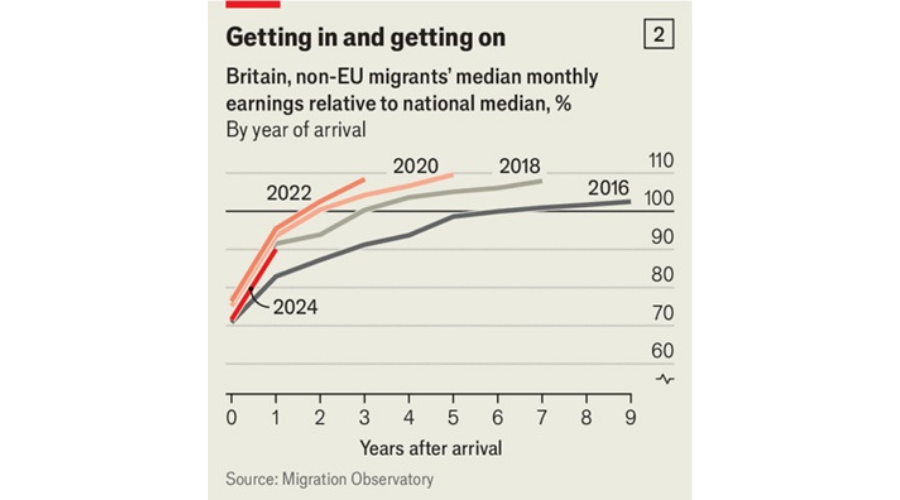
Successive governments have succeeded in making Britain less attractive to immigrants, despite the fact that they quickly contribute to the economy (see chart). Unfortunately, The Economist says, “they may also have made the immigrants who arrive less attractive to Britons,” as the number of migrant workers falls as a proportion of the total. The proposed changes to settlement and citizenship could make those who still arrive for work less successful, and thus less appealing. “Numbers aren’t everything.”
Local media need to do better on immigration reporting
The Bureau of Investigative Journalism investigated a story published by Reach’s regional outlets. Reach’s central data team produced an interactive map, with accompanying text, based on migration data published by the Office for National Statistics. The way this was then published by its various regional sites offers a stark insight into the conflicting ways the media can report the same information.
Reach-owned titles such as Surrey Live published the same data with considerably different framing, including misleading headlines that confused Ukrainian refugees with asylum seekers, generating comment sections filled with dehumanising language. Jenni Regan of Imix commented: “The human cost of that clickbait doesn’t appear in anyone’s analytics.”
Building a bigger us: How to talk about homes and immigration
FrameWorks UK, in partnership with the Joseph Rowntree Foundation and the Nationwide Foundation, have developed the evidence base on how to win hearts and minds for changes to the housing system. The research explored how the public think about homes and immigration – and how communicators who are pushing for more homes can best meet these communications challenges.
A toolkit has guidance on handling discussions about the impact on housing demand of migration.
The JRF’s Natalie Tate has written about this and there is a CIH member event on Monday 13 July.
Other news on political debates
- Research project on community cohesion. Researchers at the University of Oxford are launching a major new initiative to understand how people across the UK feel about their communities, institutions, and the future of the country. The National Conversation invites people to share what they value about community life and the kind of communities they want to build together.
- Together with Refugees has a great video on the courage which refugees need to reshape their lives in the UK.
- Leaving the ECHR would jeopardise UK national security. Former ministers claim withdrawal from the European human rights agreement is a ‘false solution’ to combat irregular migration and would make the problem worse. In the New Statesman, Marina Wheeler argues that the right is suffering from “ECHR derangement syndrome.”
- Seminar on handling far-right messaging. The Housing Diversity Network as a webinar on “Housing Crises and the Rise of the Far Right: Lessons from across Europe”, on Tuesday 14 July.
- Migration Data Tool. The BBC has an interactive migration data tool which some organisations may find useful for contextualising their communications. Full Fact also has a good explainer on recent migration figures.
- Messaging guidance. Imix points out that leading with facts alone rarely shifts attitudes, and its messaging guidance is worth reading alongside the BBC tool.