

More news items and new guides
Pre-settled status holders and domestic abuse immigration applications — policy changes
Rights of Women has produced a new guide about changes to immigration policy affecting migrant victim-survivors of domestic abuse. The guide can be accessed by clicking on ‘download additional information’ here.
It explains changes to government policy that allows migrants with pre-settled status under the EU Settlement Scheme to keep this status when they obtain another form of immigration status, including as a victim of domestic abuse.
Rights of Women is monitoring the impact of this policy change. If you know of women who are affected by this policy change and experience any difficulties, they would like to hear from you (contact nicole@row.org.uk).
Can EU settled status be cancelled?
Yes, in certain circumstances, according to Immigration and Law Experts Ltd. From 30 December 2025, the Home Office can cancel pre-settled or settled status if they believe it is more likely than not that someone helped another person make a fraudulent immigration application after 31 December 2020.
Earlier this year in the October 2025 Statement of Changes, the government updated the rules around Grounds for Refusal, including visa curtailment. They did this to make the rules more universal and simpler to understand. Now, the EUSS rules have been updated to bring them into alignment with those related to visa curtailment.
Essentially, anyone with pre-settled status who has assisted someone with fraudulently entering the UK, will now have their visa curtailed. There will be an appeal process for people who think they have grounds to appeal. However, this is not about small mistakes or misunderstandings; it is about deliberately helping with false or dishonest applications. A criminal conviction is not required
The Statement of Changes is here.
Understanding destitution and homelessness in the asylum and immigration system
Findings from NACCOM’s Annual Survey 2025 highlight a worsening national crisis of destitution and homelessness in the UK’s asylum and immigration system, driven by government policy.
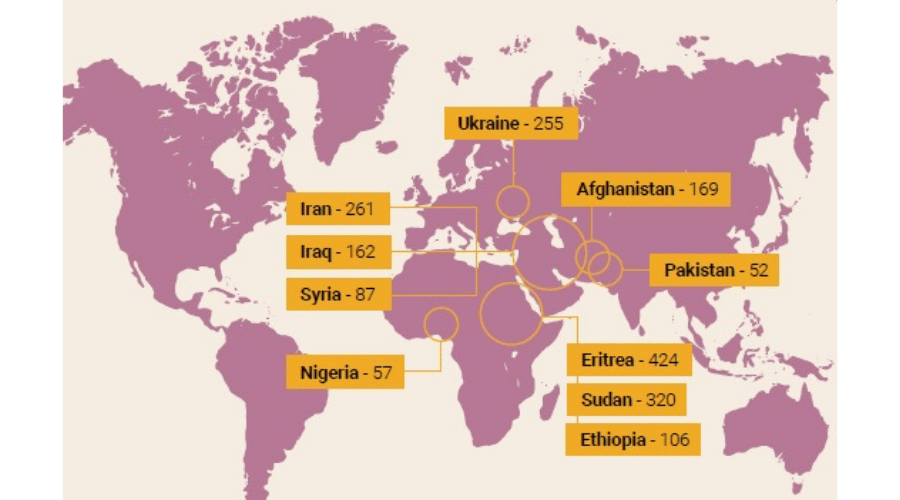
Key findings include:
- An entrenched migrant homelessness crisis
- The network accommodated 4,434 people — the highest number on record
- 829 people were rough sleeping at the point they accessed services, more than double pre-2023 levels.
- Refugees are being failed by statutory services and a shortened move-on period
- 2,008 refugees were accommodated by NACCOM members — a three per cent increase on 2023/24 and a 106 per cent increase on 2022/23
- 71 per cent of organisations said the temporary extension of the move-on period to 56 days reduced homelessness risk — a change that has since been reversed.
- NRPF conditions are forcing people into destitution
- 1,509 people with restricted eligibility or NRPF — barred from accessing most mainstream housing and homelessness support were accommodated by NACCOM members.
- Legal advice shortages place growing pressures on grassroots services
- The legal aid crisis is placing growing pressures on frontline services — 65 per cent of respondents reported an increased demand for their advice services, with nearly two-thirds unable to meet the rise in demand.
Home Office must consider whether to exercise discretion in Windrush cases
The requirements for remaining in the UK under the Windrush scheme are outlined in the Home Office’s casework guidance. For the child of a Commonwealth citizen who was settled in the UK before 1 January 1971, the guidance requires that the applicant has been continuously a resident in the UK since their birth or arrival.
The appellant in Hippolyte v Secretary of State for the Home Department [2025] EWCA Civ 1493 could not meet this requirement, reports Free Movement. It was argued that it ought to be open to her to seek to persuade the Home Office to nonetheless grant her indefinite leave to remain due to her strong and subsisting ties with the UK (the continuous-residence requirement being a proxy for demonstrating such ties). The appellant argued that, by failing to do so, the Home Office had fettered its discretion.
Digital-only immigration system is causing stress, fear and exclusion
New research by the University of Warwick with Migrant Voice has found that the Home Office digital-only immigration status is causing stress, confusion and exclusion for migrants across the UK.
The digitalisation of immigration status began in 2018 and is now mandatory for many. The findings show that people are struggling to navigate a system that is complex, glitch-prone and often lacks clear support.
Landlords’ limited awareness of share codes and inconsistent government communication, coupled with system failures during code verification, created stress and delays for migrants seeking housing who were subject to right-to-rent checks. One interviewee for the report explained that:
“… although he was able to generate a share code for housing purposes, his landlord struggled to use it. Each time the landlord entered his share code on his side, the system failed to work. In this case, the issue was eventually resolved because the landlord continued to try and because it was the two of them meeting in person. The participant reflected that had they not been in person, the landlord might not have persisted, and he could have lost the opportunity to rent the property.”
The report was also covered in the Guardian.
Judicial review granted on the Home Office eVisa policy
Free Movement reported that two organisations have raised a judicial review against the Home Office eVisa policy, via solicitors Deighton Pierce Glynn. The claim argues that providing proof of immigration status solely through digital eVisas and refusing to issue alternative proof when errors occur, or access is restricted, is illegal. Reported issues include incorrect personal or immigration details appearing in users’ accounts, difficulties accessing or updating records, and individuals being locked out of their accounts altogether.
Tackling poverty and destitution: No Recourse to Public Funds in Wales
Ahead of the Senedd election in May, a Bevan Foundation briefing outlines measures that should be taken by the next Welsh government to improve support to people with NRPF and to help prevent, as well as tackle, poverty and destitution.
The foundation calls on the next Welsh government to:
- Extend eligibility for free school meals in secondary schools to children affected by NRPF
- Develop clear practice guidance and quality standards for local authorities
- Implement a strategy for ending destitution
- Call on the UK government for an end to the NRPF visa restriction.
Roma Support Group (RSG) celebrates 2025 achievements
Some highlights from the RSG at the end of the year:
- Mishto Campaign launch: In April, RSG along with the Roma Rights Forum launched the Mishto Campaign, aiming for fairer services for Roma in schools, charities and local authorities
- Roma study: RSG supported a study conducted by the Office for National Statistics exploring the experiences of Roma people in England and Wales, due to be published soon
- New materials produced: RSG published videos on voting and vaccinations (in Slovak, Polish and Romanian), as well as a report on housing
- Media work: RSG colleagues featured on the BBC’s Sunday Morning Live programme to raise awareness of Roma history and culture to mark International Roma Day
- Holocaust Memorial in Newcastle: This August, England’s first ever permanent public Roma Holocaust Memorial was erected in Newcastle, following a campaign led by Roma Access.
Finally, for the first time, RSG and Ando Glaso organised a joint symposium in Glasgow, through the Roma Rights Forum. The event took place in September, and brought together an international panel of Roma speakers and experts exploring how to make and take space for Roma arts and heritage in Britain’s cultural sectors.

South Liverpool Homes explains its allocations policies
South Liverpool Homes (SLH) has launched a new campaign to tackle misinformation and confusion about how its homes are allocated, aiming to address myths and build stronger, fairer communities across south Liverpool. The campaign — ‘Let’s Talk Facts — Who Gets Our Homes?] — comes after a survey of more than 500 customers revealed that nearly eight in 10 people don’t fully understand how they decide who gets a home.
Many respondents believed that factors such as immigration status or ethnicity influenced decisions and feel that local people don’t have an equal opportunity to live in new homes that we build. The reality is very different. The campaign is designed to provide clear, honest answers about who gets to live in their homes through myth-busting facts and FAQs.
Anna Bishop, SLH chief executive, said:
“We know that when people feel informed and included, our neighbourhoods become stronger and more welcoming. That’s why we’re committed to tackling myths and making sure everyone understands that our homes go to those who need them most, through a fair and transparent process. By listening to our customers and acting on their feedback, we’re helping to build communities where everyone feels they belong.”
For more information about the campaign, upcoming events and how SLH allocates homes, visit the ‘Who Gets Our Homes’ webpage.
High Court finds safeguarding failures by Home Office at Brook House detention centre
Free Movement reports that, in a stinging judgment, the High Court has found that the home secretary failed to comply with an Article 3 systems duty in the operation of the rule 35 system in Brook House immigration removal centre — at least between 28 July 2023 and 11 March 2024. The case is AH and IS v Secretary of State for the Home Department [2025] EWHC 3269 (Admin).
Brief news items
- “You can’t stay but you can’t go”: State violence at the UK-France border: Humans for Rights Network’s new report documents high levels of state violence against people trying to cross the English Channel and links UK funding and policy to increased levels of violence in recent years. Contact lily@humansforrightsnetwork.com and maddie@humansforrightsnetwork.com for more information on this work.
- Additional payments factsheet: This factsheet from ASAP explains which extra payments people can get when they are on s95 and s4 support and how to apply for them.
- Why personal finance is harder when you’re a migrant: The Conversation looks at the difficulties migrants face, such as navigating unfamiliar banks and financial products, and coming up against unwritten rules — e.g. needing a good credit score to access mortgages, loans and mobile phone contracts.
- What can MPs do to help their constituents in immigration and asylum cases?: Free Movement has an anonymous article from a worker in an MP’s office, sharing their experience on how MPs can best assist migrants.
- More than 2,000 trafficked children and lone child asylum seekers missing from UK councils’ care: Charities say vulnerable young people are being failed by local authorities, the police and central government, reports the Guardian. The claim is based on the report Until Harm Ends, published by charities Missing People and ECPAT UK.
- Key issues faced by victims and survivors of modern slavery in London: Hestia has a new report, Underground Lives, on the reality of life for modern slavery survivors.
- ‘A place of welcome’: Yorkshire town rallies round to help asylum seekers: Churches and community groups in Northallerton provide food, clothing and company for refugee families, reports the FT.