
Refugee homelessness and the UK’s response to world crises
Refugee Council says a 56-day move-on period is vital to avoid homelessness
Home Office ministers finally decided, from 9 March, to set a 42-day notice period for all individuals granted leave and exiting asylum accommodation, starting from the point they are notified of a positive asylum decision. Those refused leave are still to get only 28 days’ notice. Homeless Link summarised the changes, which included the ending of the pilot 56-day move-on period.
The Refugee Council’s new report, The importance of the move-on period for refugees, looks at the brief pilot scheme and the subsequent setting of the period at 42 days. It explains the challenges that refugees face during the move-on period, and how the process could be improved — including demonstrating why a permanent extension to 56 days is essential.
Other key recommendations for the government include:
- Ensuring refugees receive all documentation required to access housing, education, employment and further support at the start of the move-on period
- Ensuring all relevant departments are informed immediately when a person is given refugee status
- Local authorities should accept an asylum grant letter as proof that a refugee is at risk of homelessness, to ensure they can access support if needed
- The government should incorporate the move-on period into their national strategy on integration.
The 28-day period fed rising homelessness
The temporary return to the 28-day move-on period in September pushed vulnerable people into rough sleeping and exposing them to fraud and abuse, says Chaminda Jayanetti in The Lead.
The change made homeless refugees “targets for the far right”, Jayanetti argues. Refugees in London were offered homelessness placements in the North or Midlands, which they were refusing because of the greater risk of suffering racial attacks. “Once councils have withdrawn their help, refugees are left to try to rent privately — and become vulnerable to fraud,” she reports.
Over 60 organisations, including CIH, wrote to the Home Secretary in October, opposing the September change in the move-on period. After receiving a negative response, NACCOM and Homeless Link put together a further reply to government ministers, which you can read here (pdf). This second letter received a reply from secretaries of state Steve Reed and Shabana Mahmood, which you can read here (pdf) — although there is little in the way of new information.
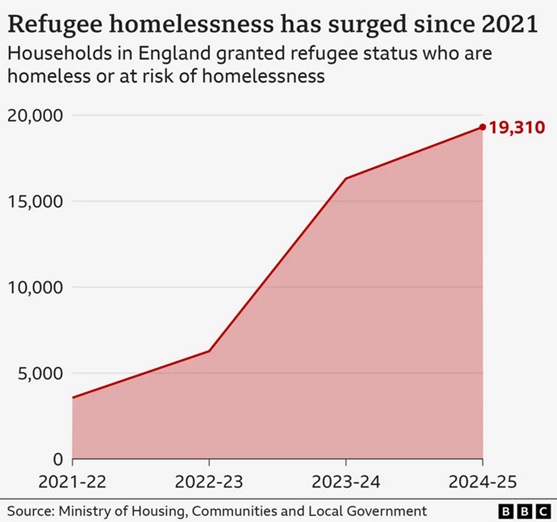
There has been a five-fold increase in the number of refugee households who are homeless or at risk of homelessness in the last four years, the BBC has found. Government data for England showed a rise from 3,560 in 2021/22, to 19,310 in 2024/25. Charities said the increase was a “direct result” of government policy.
In other responses:
- Bridget Young from NACCOM had a “little bit of a rant” at government plans that put more refugees at risk of homelessness
- More than 150 local councillors signed a joint letter asking the government to reinstate the 56-day move-on period
- A group from Manchester’s Boaz Trust joined others in a mass lobby of parliament on the move-on and ‘earned settlement’ issues
- Robina Qureshi of PAIH in Glasgow, referring to the city’s housing emergency, said that “blaming refugees will not provide a single new home, but a specific, costed strategy will”
- Fuad Mahamed of housing provider ACH, writing in Inside Housing, called for social landlords to do more to support refugees after the move-on period.
The government has published detailed analyses of its homelessness statistics, giving more details on how refugee homelessness was dealt with in the year ending September 2025. For example, of households leaving asylum accommodation, 2,360 were rehoused under the homelessness prevention duty and 6,310 under the relief duty. In each case, the majority were rehoused in the private sector, but significant proportions are in the social sector, mainly in hostels or supported accommodation.
Public attitudes to refugee sponsorship in the UK
A new report from the University of Birmingham, Public Attitudes to Refugee Sponsorship in the UK, explores how the public understands and perceives refugee sponsorship schemes. Drawing on 30 interviews, authors Natasha Nicholls, Jenny Phillimore, Gabriella D’Avino, and Marisol Reyes Soto look at attitudes in both diverse and less-diverse communities across the West Midlands and the South West of England.
They found that: “Public support for refugee sponsorship is present but conditional. Sustained expansion of sponsorship-based resettlement in the UK will depend on building confidence in the fairness, capacity and effective delivery of these schemes.”
More news on refugees and overseas crises
Syria and Afghanistan
- The quarterly immigration and asylum statistics covering the period to December 2025 have been published, giving a full picture for 2025. There were record numbers of asylum decisions, but also record numbers of refusals, raising questions about decision quality and whether the backlog is being cleared or simply deferred to tribunals. Figures show a steep decline in the grant rate for Syrian and Afghan nationals.
- The i Paper says that the Home Office is set to return asylum seekers to Syria in a bid to discourage small boat crossings, despite warnings about continuing violence and instability. The home secretary plans to increase both voluntary and enforced returns as part of wider asylum reforms, even as the government acknowledges serious security concerns in parts of the country. Charities and migration experts warn that accelerating removals could lead to more legal appeals and further pressure on the asylum system, rather than reducing the backlog.
- A senior humanitarian and ex-diplomat later told The i Paper that sending thousands of people back to Syria risked sparking a new conflict due to sectarian violence and dire humanitarian and economic conditions.
- The High Court has found an Afghan relocation refusal unlawful. The claimant challenged the rejection of his application for relocation under the Afghan Relocation and Assistance Policy (ARAP). Immediately after the substantive hearing, the Home Office withdrew the decision and agreed to retake it urgently.
- Maiwand Ahmadi Martindale fled Afghanistan with his father — his brothers remain there fearing Taliban retribution. He says: “I fled the Taliban for Britain — the Home Office visa clampdown has betrayed us.”
- Amnesty International has a new briefing explaining the barriers that women fleeing the Taliban now face if they seek sanctuary in the UK.
Ukraine
- The government has announced that the Ukraine Permission Extension (UPE) Scheme will be extended by an additional 24 months. This means that individuals will benefit from a maximum of 3.5 years’ permission under UPE, in addition to any time already provided under the Ukraine schemes.
- “From Ukraine to Scotland: Kindness helped us rebuild”, Viktoriia Vlashchuk told Bylines Scotland. “Leaving the war in Ukraine with my nine-year-old son, we found safety, education and the chance to learn and support others in Scotland.”
- Yuliia Ismail, Settled’s Ukraine schemes adviser, worked with colleagues at the University of Birmingham to submit evidence to a parliamentary inquiry on settlement. The submission draws on direct frontline experience supporting Ukrainians navigating the temporary nature of the Ukraine schemes and the challenges this creates for long-term integration.
- Andrea, a host for Ukrainian refugees in Birmingham, agreed to end the placement when her guests said they felt unsafe in an area which had “too many Muslims”, according to Channel 4 News.
- At the end of February, the government released new data on visa approvals for Ukrainians and on numbers in employment.
Iran
- Iran has been the most common country of nationality among asylum applicants and small boat arrivals to the UK in recent years. The UK has also been the most common European destination for Iranian asylum seekers. There were around 114,000 Iranian-born people living in the UK at the time of the 2021/22 Census. This commentary examines data on Iranian migration to the UK through seven charts.
- Interestingly, the Islamic Republic of Iran is one of the world’s biggest refugee hosts, with 2.5 million refugees from Afghanistan and elsewhere. As of late March 2026, the United Nations refugee agency (UNHCR) estimates that up to 3.2 million people have been internally displaced within Iran following the start of US-Israeli strikes on February 28.
- British nationals who must leave countries affected by the war against Iran are exempt from the habitual residence test if the UK government has advised British nationals to leave or arranged an evacuation. This means that, if they come to the UK, they are eligible for housing assistance and benefits. This is explained on the Housing Rights website (see ‘Who is exempt‘). Note that this works for any subsequent new emergencies, provided the government has issued advice to leave or arranged evacuation (but in each case only during a six-month window period).
Sudan
- Asylos has a detailed report on the dire situation within the El Fasher region of Sudan.
Hong Kong
- Councils are no longer be able to access funding through the Hong Kong Welcome Programme. The government announced that destitution funding for the Hong Kong BN(O) UK Welcome Programme ended on 31 March. The programme, introduced in 2021, enabled the creation of welcome hubs and services delivered by local authorities and voluntary sector organisations.
- The BN(O) visa is issued with a No Recourse to Public Funds (NRPF) condition. However, a person can apply to the Home Office for a Change of Conditions to lift the NRPF condition if they are destitute or at risk of destitution.