
Refugee homelessness spikes as Home Office policy changes
Journalist Chaminda Jayanetti recently wrote about refugee homelessness on his blog, Policy Matters. With Chaminda’s permission, we have reproduced a lengthy extract from that article here.
Government figures published on April 30 show a big spike in homelessness caused by people having to leave Home Office accommodation.
The rise coincides with the Home Office deciding to cut how long newly accepted refugees are given to find somewhere to live before booting them out of ‘asylum hotels’ and the like. You don’t say.
It works like this. Asylum seekers who can’t fund their own accommodation are housed by the Home Office, while their asylum applications go through the system. This is usually in contracted hotels or in privately managed flats and housing.
Once the Home Office has decided someone’s asylum claim, the applicant has to leave their accommodation within a set time. If their claim has been refused, they are generally barred from getting formal homelessness support from local government.
But even if they are accepted as a refugee, they are effectively welcomed to this country with a scramble to find new accommodation — which may include approaching their local council for formal help to prevent homelessness (if they are threatened with homelessness) or relieve homelessness (if they are already homeless).
Chart 1 (below) shows how many people were granted either a ‘prevention’ duty or a ‘relief’ duty by their local council each quarter, where the recorded reason was “required to leave accommodation provided by Home Office as asylum support”.

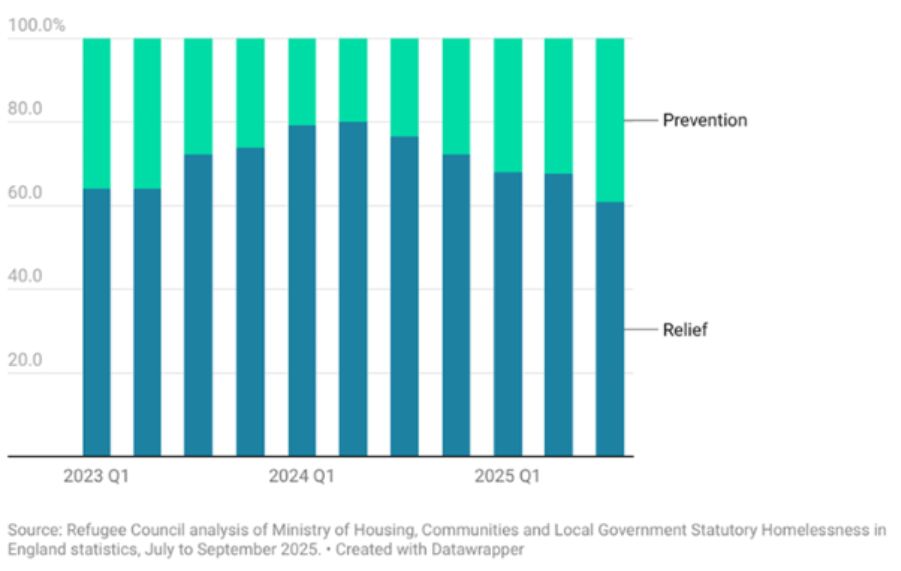
The main driver of these figures is arguably fluctuations in the number of people granted asylum. You can see how the two relate in this chart from a recent Refugee Council report, published before the most recent homelessness data (chart 2, below).

But it won’t shock you to discover that some of those shifts in numbers also coincide with changes in Home Office policy.
In the past, successful asylum applicants were given 28 days to move out of Home Office accommodation — a timeframe that was widely seen as too short to enable them to find affordable housing.
But in December 2024, the Labour government doubled the move-on period to 56 days in what was initially a six-month pilot. Homelessness cases went into decline as refugees were given longer to find new homes. The Refugee Council report noted that asylum homelessness cases started shifting towards ‘prevention’ duties rather than ‘relief’ duties — indicating the additional time allowed to councils to intervene before people actually became homeless.
This pilot was then extended to the end of 2025. But amid government panic over protests outside ‘asylum hotels’, the Home Office abruptly brought back the 28-day limit for all single adults from 1 September last year (exceptional cases were exempted: pregnant women, over-65s, disabled people).
It was one of Yvette Cooper’s last acts as Home Secretary. And as you can see in Chart 1, the most recent figures — from the final three months of 2025 — show a resurgence in homelessness cases, particularly relief duty (orange) rather than prevention duty (blue).
As the Refugee Council’s Jon Featonby flagged, nearly 6,000 households in three months (assuming no double-counting between prevention and relief cases) were given homelessness support by councils after being cut off from Home Office support — a 36 per cent rise in one quarter.
In short, the thing that everyone said would happen has happened.
So, what now? The most recent data doesn’t cover this year’s Home Office decision to settle on a 42-day time limit — which, you may notice, happens to be slap bang in the middle of 28 days and 56 days. Uh-huh. The Refugee Council report noted there was “no clear explanation” why a 42-day limit was chosen.
I suspect the Home Office is trying to split the difference between its aim of clearing out and shutting ‘asylum hotels’ as soon as possible and not triggering a full-blown homelessness crisis for councils to pick up. Aside from the political toxicity of asylum-seeker housing, it’s national government that funds it, whereas a lot of the cost of homelessness support falls on councils. But on the flip side, Labour governments tend to listen to urban councils more than the Tories. Plus, intensive lobbying by refugee organisations will have had an effect.
So, what we’re left with is the government muddling through, leaving a problem that perhaps won’t hit full-blown crisis levels with the 42-day limit, but will fester and do significant avoidable harm with no real resolution. Just for once.