

More news items and new guides — May 2026
Here is a round-up of this month’s policy developments and related news.
Government policy: Latest developments
Reforming asylum support and enforcing family returns
The government consultation on major changes to asylum support and the enforcement of family returns is now open until June 4. Next month’s newsletter will include sector reactions.
In the meantime:
- The Refugee Council has produced a briefing note for the sector’s response to the changes
- ASAP, the Asylum Appeals Support Project, summarised the proposals and produced a detailed briefing
- The NRPF Network has produced guidance for councils on the changes.
CIH is opposed to the asylum support changes and will be responding accordingly.
‘Earned settlement’ proposals
Under a planned system of ‘earned settlement’, migrants would face longer or shorter routes to settlement based on factors such as their visa type, earnings and language proficiency. There is speculation about when the proposals will take effect, with the consensus emerging around ‘the autumn’.
The Immigration Law Practitioners’ Association (ILPA) has a new briefing paper that describes the policy as “largely without precedent” in both domestic and international contexts. The paper notes that plans for a 10-year baseline qualifying period for settlement/indefinite leave to remain (ILR) would be unprecedented for the UK and far longer than in most comparable countries.
There is huge concern about the effects on care workers. UNISON held a day of action on the proposals, calling on the government to scrap its plans. The Guardian said “Britain risks undermining the care workers it depends on”. International staff make up almost 30 per cent of the care workforce, but recruitment of migrant staff is down more than 80 per cent, according to the latest figures.
Some foreign nationals face up to 30 years in visa limbo under the changes to settlement. The Independent raised the issue of vulnerable people being unaware of how they are affected. One said: “I live in a care home after three strokes — new visa rules mean I’ll be in my eighties before I’ll know if I can stay in the UK.”
Family reunion
Refugee family reunion was suspended by the government for new applications from September 2025, leaving many children unable to access the protection they need. The Red Cross predicts that between 550 and 1,360 children could remain separated from their families for every month the refugee family reunion suspension continues.
It has urged the government to reinstate the scheme as soon as possible.
Legislation announced in the King’s Speech
In May’s King’s Speech, the government announced plans for a new immigration bill, which it says will “deliver a firm but fair immigration system that restores control and earns public trust”.
According to background briefing notes, the bill will build on measures introduced since 2024 and implement proposals first set out in the government’s Restoring Order and Control statement in November 2025. The bill aims to simplify the asylum system, moving towards a ‘core protection’ model that will be time-limited rather than permanent.
The proposals have been trailed in earlier consultation papers. Free Movement commented: “Yes, that noise you can hear is indeed the sound of the bottom of a barrel being scraped. It’s just pathetic.”
Chasing public opinion, UK immigration policy has swung cyclically
An article published in the US examines the reactionary swings in UK labour migration policy over the last 15 years. It argues that political salience and arguments about control and economic needs have driven governments’ almost cyclical policy reversals. “Policymakers have sought a balance between controlling migration and letting in enough workers to mitigate labour shortages,” it concludes.
Refugees from overseas crises
Dan Sohege writes about how current policy affects those seeking asylum from a range of world crises from Eritrea to Yemen, “risking lives and wasting money.”
The government has set out a new overview of “safe and legal routes”.
Palestine. Scotland’s highest civil court intervened to stop Home Office extinguishing a Gaza family’s hopes of being reunited.
Sudan. Sudanese asylum seekers are challenging Home Office policy changes. Two asylum seekers, both of whom have nightmares and flashbacks about being tortured in their home country, argue that current policy is indirectly discriminatory and would not act as a deterrent to asylum seekers. In 2025, 96 per cent of Sudanese asylum claims resulted in a grant of protection.
Afghanistan. Latest news on the plight of people escaping Afghanistan:
- “After halting a U.S. resettlement program for Afghans who helped the American war effort, President Trump is in talks to send as many as 1,100 of them to the Democratic Republic of Congo,” reports the New York Times
- Rakib Ehsan argues in UnHerd that the home secretary should negotiate with the Taliban to secure the return of Afghan asylum seekers
- In a written statement made on 28 April 2026, the government confirmed there will be changes to the Afghan Resettlement Programme
- A record 7,330 Afghans — including 1,670 migrants who crossed the Channel on small boats — had their asylum claims rejected last year.
Ukraine. The Council of Europe’s Commissioner for Human Rights looks at the solidarity shown towards Ukrainian refugees across Europe, and how this is now at risk.
Renters’ Rights Act takes effect in England
On 1 May 2026, the first phase of reforms in the Renters’ Rights Act were implemented.
Section 21 ‘no fault’ evictions are abolished, giving renters far greater security and stability. Fixed-term tenancies are banned. Instead, tenancies will become periodic, with tenants able to give two months’ notice at any point. Landlords will have access to a range of new possession grounds so they can get back their property when they need to.
Some barriers that stop people from finding a place to rent will be removed. This includes demands for large amounts of rent in advance and discrimination against renters who have children or are on benefits. Rental bidding will be banned, meaning landlords cannot ask for, encourage or accept offers over the published asking price. If tenants think a rent increase is above the open market rate, they will be able to challenge it at the First-tier Tribunal.
The government has published tenant and landlord toolkits to assist with implementation.
Poor communication and misinformation fuelling tensions over asylum hotels
In new research, IPPR finds that asylum hotels have become flashpoints for frustration because of how they are used and managed: often introduced with little local input, limited transparency and no clear sense of benefit for the communities hosting them.
They recommend:
- A clear duty to notify and consult local authorities, including a 12-week notice period before new accommodation is brought into use
- Provide a local community dividend to areas which have hosted asylum hotels by investing in local infrastructure — this would be based on the savings made from closing asylum hotels over the course of the parliament
- Speed up efforts to close hotels this parliament by buying and repairing substandard properties, using the £500 million funding already announced by government, to create more temporary accommodation for both asylum seekers and local residents at a lower cost than hotels.
Proposals from IPPR, Refugee Action and the Commission for the Integration of Refugees have all set out how asylum accommodation could be better delivered through a decentralised, locally delivered not-for-profit model.
In other news:
- The Greater Manchester Asylum Hotels Group set out its vision for how people should be housed while waiting for an asylum decision. The group is made up of people with experience of living in asylum accommodation who have come together to be a voice for change. The group’s vision is “a crucial reminder that whatever comes next, human beings need to be at centre [sic]”.
- Asylum contractor Serco recently held its annual general meeting. Groups campaigning on issues ranging from climate justice to detention to modern slavery took action at the AGM. They confronted Serco’s Board and shareholders with testimonies and questions from neighbours and friends with experience of Serco’s asylum accommodation and immigration detention centres.
The State of Social Cohesion in 2026 — More in Common
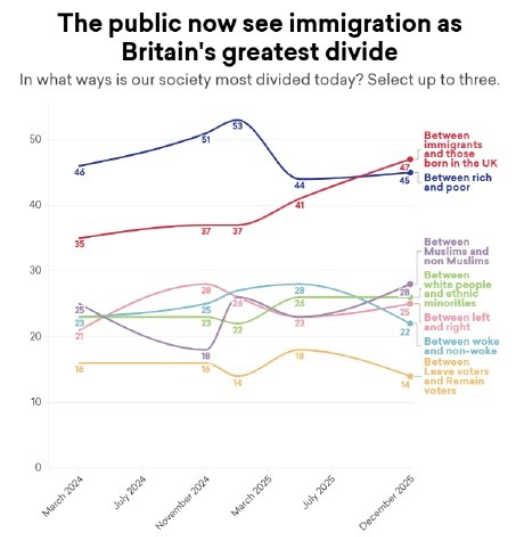
West Midlands’ Strategic Migration Partnership reviewed a More in Common report on social cohesion in 2026, which highlights a growing sense of division in public attitudes linked to migration. Nearly half of Britons (47 per cent, see chart below) now identify the divide between migrants and those born in the UK as one of the country’s most significant social divides, overtaking concern about inequality between rich and poor.
The findings reflect the increasing salience of migration in national debate and differing views on whether social differences are seen as manageable or becoming more entrenched.
Project 17’s work with people who have no recourse to public funds
Project 17 works to end destitution among people with no recourse to public funds. It is expanding its remit and will be taking over much of the work done by the Care Rights Project between now and October.
The Care Rights Project will continue to provide second-tier advice to professionals supporting adult migrants with care needs and no recourse to public funds until the start of September 2026 via this form.
Project 17 will continue to provide all their usual services for families with NRPF. It is expanding its remit to provide advice and advocacy to adults with NRPF who have care needs and need to access support from their local authority.
Project 17 is able to take some self-referrals for casework for adults with care needs via this form.
News on domestic abuse and housing support
- The House of Commons library has a new briefing on domestic abuse and housing support
- “When domestic abuse survivors don’t fit the rules: options and risks” — a new briefing from Free Movement
- The BBC has investigated the validity of claims under the domestic abuse concession.
New from the Migration Observatory
Here are some of the Migration Observatory’s latest briefings:
- EU citizens living in the UK
- The Impact of Migration on UK Population Growth
- The UK’s asylum backlog.
The briefing on the UK asylum backlog shows that, while the initial asylum decision backlog has fallen sharply, pressures have shifted to the courts. The initial backlog dropped to 49,000 applications at the end of 2025, the lowest level since 2020, driven by a significant increase in decision-making. But the backlog of asylum appeals almost doubled, reaching a record 80,000 applications.
Other news items
- Right to Rent checks. The government launched a consultation on a draft code of practice for landlords on avoiding unlawful discrimination when conducting ‘right to rent’ checks in the private rented sector (CIH’s response).
- Engagement with local authorities on asylum accommodation. Here is CIH’s response to a consultation by the Independent Chief Inspector of Borders and Immigration.
- Out-of-area homelessness accommodation in England. The House of Commons has an overview of local housing authorities’ legal duties when arranging homelessness accommodation outside their area.
- EU Settlement Scheme. The government has news on automating grants of settled status and removing pre-settled status from those not eligible. Free Movement explains the changes.
- Refugee integration. The government has published data and analysis on the long-term outcomes of refugee integration.
- Seasonal workers. In Precarious by design… Focus on Labour Exploitation analyses how irregularity is directly connected to the government’s design of migration routes.
- New to Sheffield. New to Sheffield helps people new to the city find trusted information, support and services. Its page on housing links to the Housing Rights website.
- ACH refugee engagement pilot. Refugee and migrant housing provider ACH has received government funding for refugee tenant engagement following the rise in hate crime and far-right activities in recent months. A total of £76,442 from the latest round of the Social Housing Innovation Fund will go towards engaging refugee tenants.
- Windrush. Melissa Sigodo’s powerful four-part Windrush series includes the devastating experiences of Hetticia (“Tricia”) and Vanderbilt (“Vaun”) McIntosh — and the lasting impact the Windrush scandal has had on their family.
- No recourse to public funds. A new explainer has been published by Free Movement (see also the Housing Rights website explainer here).
- Immigration raids in Belfast. End Deportations Belfast claims that racial profiling is being undertaken before immigration raids are launched. The Irish News reports that “Racist violence is spiralling out of control.”
- Asylum seekers in Scotland. “No, 10% of the UKs [sic] asylum seekers are not being held in Scotland” — this claim from Reform UK was made in leaflets landing on doorsteps in Scotland. The figure is incorrect — the real figure is around six per cent.
- Care4Calais is campaigning to end the one-in-one-out pilot for sending asylum seekers to France. An Early Day Motion has been launched in the House of Commons.
Finally, the Office for National Statistics issued its latest migration estimates, for the year ending December 2025. Overall net migration in 2025 was just 171,000 — down from 331,000 a year earlier. A fall in non-EU immigration is the main driver.